Thursday, January 21, 2010

Krump


Krump essentially stands for Kingdom Radically Uplifted Mighty Praise. A popular form of freestyle street dance, Krump dance or Krumping is very energetic and volatile in nature. The versatility factor in this dance enables different people to adapt it according to their own personality or what suits them the best. Now that this dance has evolved from its primitive stage, there is a defined structure and defined styles of Krumping. It is often confused with clown dancing, though both are separate forms of dancing. Infact, Krump dancing can be regarded as an off-shoot of clown dancing .This form of dancing has Christian roots. It basically began as vent to release anger, aggression and frustration positively, in a non-violent way. This was in opposition to street violence, which was much prevalent due to violent gangster activities. This dance was popularized by the documentary movie ‘Rize’, which gave the world a glimpse into this free-style form of dancing that was being popularized on the streets of Southern California. Krumping began with Tommy the Clown (hip-hop dancer) and his group of Krump crews. It was introduced in the early 90’s and was quickly lapped up by the privileged classes.

With time and growing popularity, more and more people came to know about it and found it to be an interesting way of releasing the pent-up aggression, non-violently. Gradually, it came to be followed and learnt by people from different regions was slowly given different styles by people from various regions. Different regions altered this form of dance in their own though the basic idea remained the same. Initially, the face was painted in colorful tones, to represent a clown. However, with time, sophistication took over and the use of paints became a matter of personal choice and expression


An urban street dance form that began in Los Angeles, Krumping has spread its wings quite wide today. The growing popularity has made it a well-known form of dance style that also has an aspect of fashion embedded in it! Right from what is to be worn and which color paints are to be used, everything has now a structured pattern and definite style. However, it continues to be characterized by free, expressive, and highly energetic moves of the arms, head, legs, chest and feet. A major part of hip hop culture, it is used frequently in hip-hop street dance battles as well.


Krumping comprises of a number of styles within itself, the most common of which are dissing (from disrespectful) and sick' movements such as grimey and snaking, as well as beasty, bully, cocky, flashy, goofy (regarded as the least aggressive), jerky, rugged, and tricks. In this style of dancing, the dancers organize themselves into groups known as families' or fams'. Leading the group is the senior dancer, called a Big Homie, who serves as the instructor, mentor, as well as the de facto sibling to the younger and less experienced Lil' Homies (junior dancers).

Wednesday, January 13, 2010

Vietnam


Population

85,789,573


Capital

Hanoi


Language spoken

Vietnamese


Bordering countries

Cambodia,Laos,and china
Name of Currency
Dong

Tuesday, January 12, 2010

Iditarod Trail sled dog


The Iditarod Trail Sled Dog Race, usually just called the Iditarod, is an annual sled dog race in Alaska, where mushers and teams of typically 16 dogs cover 1,161 miles (1,868 km) in eight to fifteen days from Willow (near Anchorage) to Nome. The race begins on the first Saturday in March -- the 2010 race will begin on March 6th. The Iditarod began in 1973 as an event to test the best sled dog mushers and teams, evolving into the highly competitive race it is today. The current fastest winning time record was set in 2002 by Martin Buser with a time of 8 days, 22 hours, 46 minutes, and 2 secondsv

Teams frequently race through blizzards causing whiteout conditions, sub-zero temperatures and gale-force winds which can cause the wind chill to reach −100 °F (−73.3 °C). The trail runs through the U.S. state of Alaska. A ceremonial start occurs in the city of Anchorage and is followed by the official restart in Willow, a city in the south central region of the state. The restart was originally in Wasilla, but due to too little snow, the restart was permanently moved to Willow in 2008.[2] The trail proceeds from Willow up the Rainy Pass of the Alaska Range into the sparsely populated interior, and then along the shore of the Bering Sea, finally reaching Nome in western Alaska. The teams cross a harsh landscape under the canopy of the Northern Lights, through tundra and spruce forests, over hills and mountain passes, and across rivers. While the start in Anchorage is in the middle of a large urban center, most of the route passes through widely separated towns and villages, and small Athabaskan and Inupiat settlements. The Iditarod is regarded as a symbolic link to the early history of the state, and is connected to many traditions commemorating the legacy of dog mushing. The trails alternate each year -- every even year they take the north trail and odd years they take the south trail.

Thursday, December 17, 2009


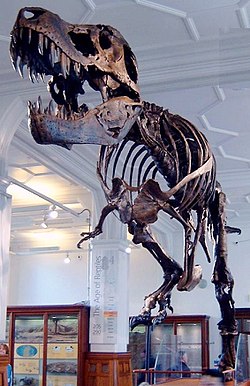
Tyrannosaurus (pronounced /tɨˌrænɵˈsɔrəs/ or /taɪˌrænɵˈsɔrəs/, meaning 'tyrant lizard') was a genus of theropod dinosaur. The species Tyrannosaurus rex ('rex' meaning 'king' in Latin), commonly abbreviated to T. rex, is a fixture in popular culture. It lived throughout what is now western North America, with a much wider range than other tyrannosaurids. Fossils are found in a variety of rock formations dating to the last three million years of the Cretaceous Period, approximately 68 to 65 million years ago. It was among the last non-avian dinosaurs to exist prior to the Cretaceous–Tertiary extinction event.
Like other tyrannosaurids, Tyrannosaurus was a
bipedal carnivore with a massive skull balanced by a long, heavy tail. Relative to the large and powerful hindlimbs, Tyrannosaurus forelimbs were small, though unusually powerful for their size, and bore two clawed digits. Although other theropods rivaled or exceeded Tyrannosaurus rex in size, it was the largest known tyrannosaurid and one of the largest known land predators, measuring up to 13 metres (43 ft) in length,[1] up to 4 metres (13 ft) tall at the hips,[2] and up to 6.8 metric tons (7.5 short tons) in weight.[3] By far the largest carnivore in its environment, Tyrannosaurus rex may have been an apex predator, preying upon hadrosaurs and ceratopsians, although some experts have suggested it was primarily a scavenger. The debate over Tyrannosaurus as apex predator or scavenger is among the longest running debates in paleontology.

Wednesday, December 16, 2009

Atilia the hun


widely known as Attila the Hun, was the Emperor of the Huns from 434 until his death in 453. He was leader of the Hunnic Empire which stretched from Germany to the Ural River and from the River Danube to the Baltic Sea (see map below). During his rule, he was one of the most fearsome of the Western and Eastern Roman Empires' enemies: he invaded the Balkans twice and marched through Gaul (modern France) as far as Orleans before being defeated at the Battle of Chalons. He refrained from attacking either Constantinople or Rome. His story, that the Sword of Attila had come to his hand by miraculous means, was reported by the Roman Priscus.
In much of
Western Europe, he is remembered as the epitome of cruelty and rapacity. However he is regarded as a hero and his name is revered and used in Hungary, Turkey and other Turkic-speaking countries in Central Asia. Some histories and chronicles describe him as a great and noble king, and he plays major roles in three Norse sagas: Atlakviða; Völsunga; and Atlamál.[citation needed]
He is reported as being "short of stature, with a broad chest and a large head; his eyes were small, his beard thin and sprinkled with grey; and he had a flat nose and tanned skin..."
[1]

Monuments in eater island


In one of the most remote spots on Earth, separated by more than two thousand miles of ocean from the nearest centers of civilization, is a lone, triangular-shaped island that occupies about 64 square miles of the Pacific Ocean, which spans 70 million square miles. On the island's southeast coast stand nearly a hundred huge, megalithic monuments carved in a stylized manner to resemble male human heads with elongated facial features. Some 800 additional statues remain in a quarry or scattered about the island.
The statues average about 13 feet in height, 5 feet in width, and weigh an average of 14 tons; they stand on stone platforms averaging 4 feet in height. Islanders call the statues "moai," and the platforms are called "ahus," but the megaliths abound in mystery: who carved them and what is their significance Inhabitants call the island Rapa Nui. Europeans have known it as Easter Island since the first recorded contact in 1722 by the Dutch explorer Jacob Roggeveen (1659– 1729). The island is also known as Isla de Pascua in Spanish, the language of Chile, the South American country that annexed the island in 1888. But Chile, on the closest continent to Easter Island, lies 2,300 miles to the east. Tahiti, the nearest large island to the west, is 2,500 miles away from Easter Island. It is 1,500 miles to the nearest area of human habitation, Pitcairn Island. Another mystery, then, is how the island came to be populated, and how the isolated island people managed to make and move the immense moai.

Wednesday, December 9, 2009

Theodore Roosevelt


Theodore D. Roosevelt (October 27, 1858 – January 6, 1919;[2] pronounced /ˈroʊzəvɛlt/[3])[4] was the 26th President of the United States. He is well remembered for his energetic persona, his range of interests and achievements, his leadership of the Progressive Movement, his model of masculinity, and his "cowboy" image. He was a leader of the Republican Party and founder of the short-lived Bull Moose Party of 1912. Before becoming the 26th President (1901–1909) he held offices at the municipal, state, and federal level of government. Roosevelt's achievements as a naturalist, explorer, hunter, author, and soldier are as much a part of his fame as any office he held as a politician.
Born to a wealthy family, Roosevelt was an unhealthy child suffering from asthma who stayed at home studying
natural history. In response to his physical weakness, he embraced a strenuous life. He attended Harvard, where he boxed and developed an interest in naval affairs. A year out of Harvard, in 1881 he ran for a seat in the state legislature. His first historical book, The Naval War of 1812, published in 1882, established his reputation as a serious historian. After a few years of living in the Badlands, Roosevelt returned to New York City, where he gained fame for fighting police corruption. He was effectively running the US Department of the Navy when the Spanish American War broke out; he resigned and led a small regiment in Cuba known as the Rough Riders, earning himself the Medal of Honor. After the war, he returned to New York and was elected Governor; two years later he was nominated for and elected Vice President of the United States.